■ 그래픽디자인ㅣ더미디어저널리스트 ■
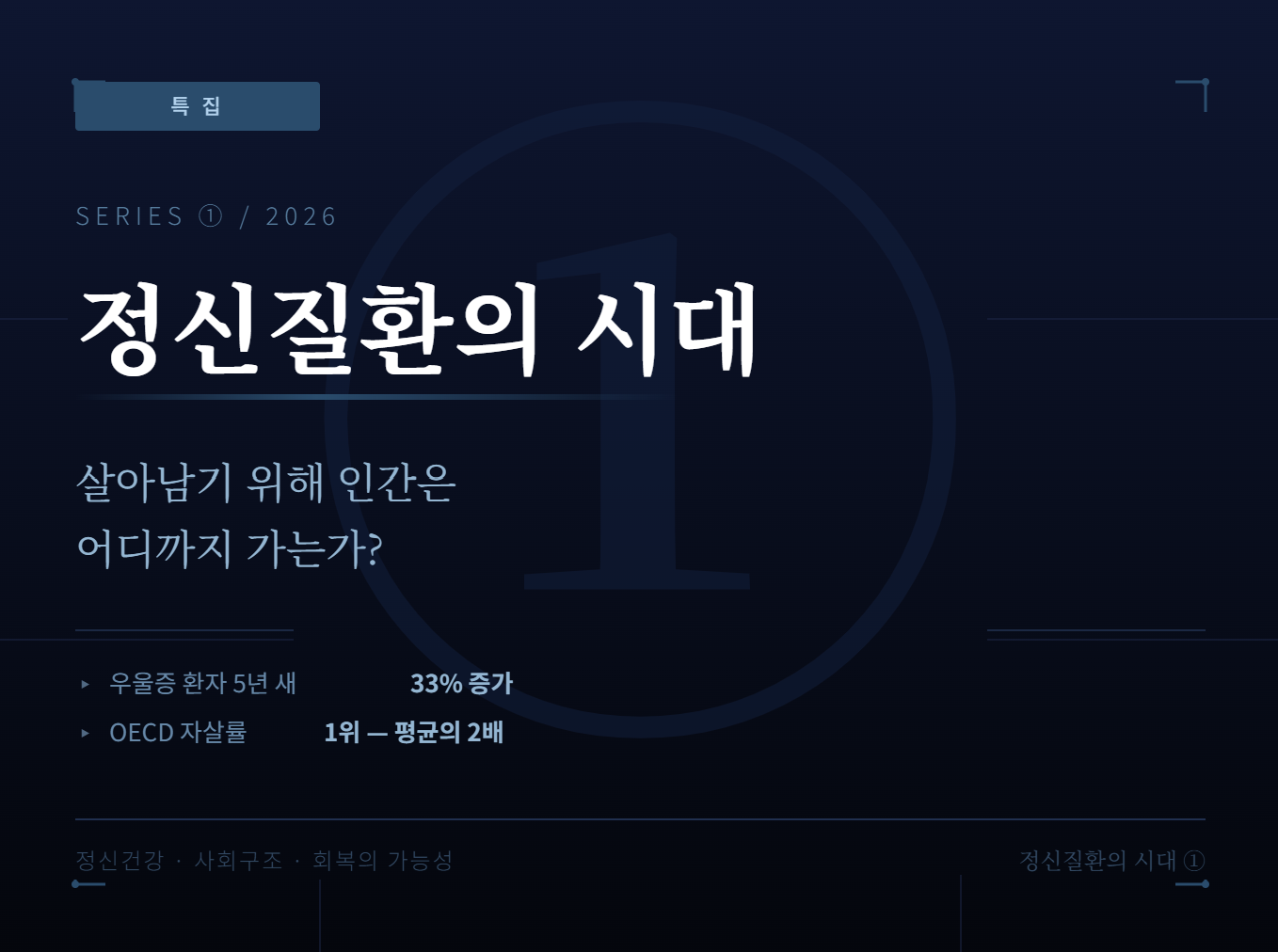
살아남기 위해 인간은
어디까지 가는가
생존이 최고의 가치가 된 사회, 그리고 무너지는 마음들
우울증은 의지가 약해서 생기는 것이고, 공황장애는 마음이 약한 사람에게 오는 것이며, 불안은 성격의 문제라고 말한다. 그러나 정말 그럴까.
오늘날 우리는 역사상 가장 풍요로운 시대를 살고 있다. 스마트폰 하나로 전 세계와 연결되고, 클릭 한 번으로 원하는 정보를 얻는다. 먹을 것이 넘쳐나고, 기술은 발전했으며, 평균수명도 늘어났다.
그런데 이상하다.
왜 사람들은 점점 더 불안해할까.
왜 우울증은 늘어나고, 공황장애는 흔한 질환이 되었으며, 수많은 사람들이 불면의 밤을 보내고 있을까.
불안장애도 마찬가지다. 건강보험심사평가원 보도자료(2022)에 따르면, 2017년 대비 2021년 불안장애 환자는 32.3%(연평균 7.3%) 증가했으며, 그 속도는 20대에서 가장 빨랐다 — 같은 기간 20대 불안장애 환자는 무려 86.8% 늘었다.
건강보험심사평가원 『생활 속 질병·진료행위 통계』(2023) / 건강보험심사평가원 보도자료 「최근 5년 우울증과 불안장애 진료현황 분석」(2022)
풍요로운 시대에, 마음은 오히려 더 빠르게 무너지고 있다. 문제는 개인의 마음속에만 있는 것이 아닐 수 있다. 어쩌면 우리는 지금 ‘생존 자체가 경쟁이 된 시대’를 살고 있는지 모른다.
누군가는 승진을 위해 경쟁하고, 누군가는 계약 연장을 위해 눈치를 본다. 누군가는 생활비를 걱정하고, 누군가는 월세를 걱정한다.
이 과정에서 사람들은 점점 자신을 잃어간다. 살아남기 위해 거짓말을 하기도 하고, 타인을 공격하기도 하며, 자신의 양심을 타협하기도 한다.
원래 그런 사람이어서가 아니다.
생존이 위협받는 상황에서 인간은 생각보다 쉽게 무너질 수 있기 때문이다.
살아남기 위해 선택한 수많은 타협과 긴장은 결국 마음속에 쌓인다.
현대 정신의학은 정신질환을 단순히 의지의 문제로 설명하지 않는다. 유전적 요인, 신경학적 요인, 환경적 요인, 사회적 요인이 복합적으로 작용한다고 본다.
그 가운데 우리가 주목해야 할 것은 사회적 요인이다.
사람은 혼자 살아가지 않는다. 사회가 병들면 사람도 병든다.
서로를 경쟁자로만 바라보는 문화, 실패를 용납하지 않는 분위기, 끊임없이 비교하는 SNS, 언제든 대체될 수 있다는 불안감 — 이러한 환경은 정신건강을 위협하는 거대한 압력으로 작용한다.
경제 규모 세계 14위(GDP 기준, 2023년 약 1조 7,000억 달러)인 나라에서, 스스로 목숨을 끊는 비율도 세계 1위라는 사실 — 이것이 우리 사회가 보내는 신호다.
질병관리청 국가손상정보포털 / OECD Health Statistics / 한국생명존중희망재단 『데이터 ZOOM』(2024)
오늘날 정신질환은 특정 개인만의 문제가 아니다. 누군가의 우울증은 우리 사회의 초상일 수 있고, 누군가의 공황장애는 경쟁사회가 남긴 상처일 수 있다.
이제는 질문을 바꿔야 한다.
“우리는 왜 이렇게 되었을까?”정신건강의 위기는 개인의 실패가 아니라 시대의 신호일 수 있다. 그리고 그 신호를 외면할수록 문제는 더욱 깊어진다.
다행히 인간은 무너지기도 하지만, 회복하기도 한다.
문제를 개인의 실패로 보지 않고 사회의 구조로 바라볼 때,비로소 변화가 시작된다.
『정신질환의 시대』는 이 질문에서 출발한다.
우리는 왜 불안해졌는가.
왜 외로워졌는가.
왜 쉽게 무너지는가.
그리고 무엇이 우리를 다시 회복으로 이끌 수 있는가.
How Far Will Humans Go
to Survive?
A society where survival is the highest value — and the minds that break under its weight
Depression, we say, comes from a lack of willpower. Panic disorder happens to weak-minded people. Anxiety is just a personality trait. But is that really true?
We live in the most prosperous era in human history. A single smartphone connects us to the entire world. One click delivers any information we need. Food is abundant, technology advances, and life expectancy has never been longer.
And yet — something is wrong.
Why are people growing more anxious by the day?
Why is depression on the rise? Why has panic disorder become commonplace, and why do so many people lie awake through the night?
Anxiety disorders followed the same trajectory. Per HIRA’s 2022 report, anxiety disorder patients grew by 32.3% (averaging 7.3% per year) between 2017 and 2021 — with the steepest rise among people in their twenties, whose numbers surged by 86.8% over the same period.
HIRA, Disease and Medical Practice Statistics (2023) / HIRA Press Release, “Five-Year Trends in Depression and Anxiety Disorder Treatment” (2022)
In an age of abundance, our minds are unraveling faster than ever. The problem may not lie within the individual. Perhaps we are living in an era where survival itself has become a competition.
Some compete for promotions. Others anxiously read the room, hoping to have their contracts renewed. Some worry about groceries. Others about rent.
In the process, people slowly lose themselves. To survive, they tell lies, lash out at others, or compromise their conscience.
Not because that is who they are.
But because when survival is threatened, human beings break far more easily than we think.
All the compromises and tensions chosen in the name of survival accumulate — quietly, invisibly — in the mind.
Modern psychiatry does not explain mental illness as a simple failure of willpower. It recognizes that genetic, neurological, environmental, and social factors all interact in complex ways.
Among these, the social factor deserves our closest attention.
No one lives alone. When a society grows sick, so do its people.
A culture that sees everyone as a rival. An atmosphere that tolerates no failure. Social media built on relentless comparison. The constant fear of being replaced — these forces press down on mental health like a vast, invisible weight.
The world’s 14th-largest economy by GDP (approximately $1.7 trillion in 2023) also leads the world in the rate at which its people choose to end their lives. This is the signal our society is sending.
KDCA National Injury Information Portal / OECD Health Statistics / Korea Foundation for Suicide Prevention, Data ZOOM (2024)
Mental illness today is not the burden of a particular individual. One person’s depression may be a portrait of our entire society. Another’s panic disorder may be the scar left by a culture of relentless competition.
It is time to change the question.
“Why have we ended up this way?”The mental health crisis may not be a personal failure — it may be a signal of our times. And the longer we ignore that signal, the deeper the problem grows.
Fortunately, humans do not only break — we also heal.
When we stop seeing the problem as individual failureand begin to see it as a structural one,
change becomes possible.
The Age of Mental Illness begins with this question.
Why have we become so anxious?
Why have we become so lonely?
Why do we break so easily?
And what might lead us back toward recovery?
저작권자 © '더미디어저널리스트' 무단전재 및 재배포, AI학습 및 활용 금지

작성자 소개